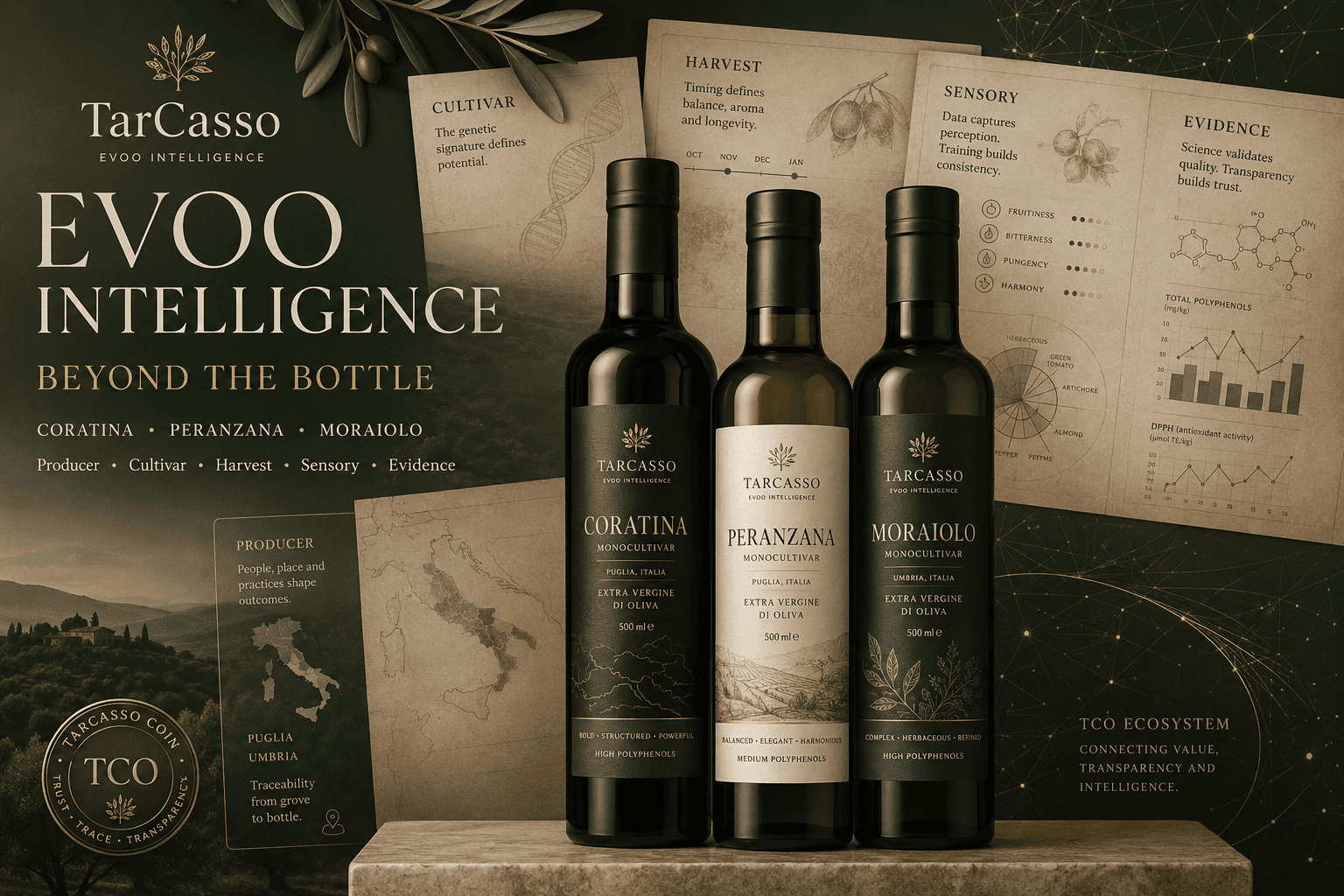
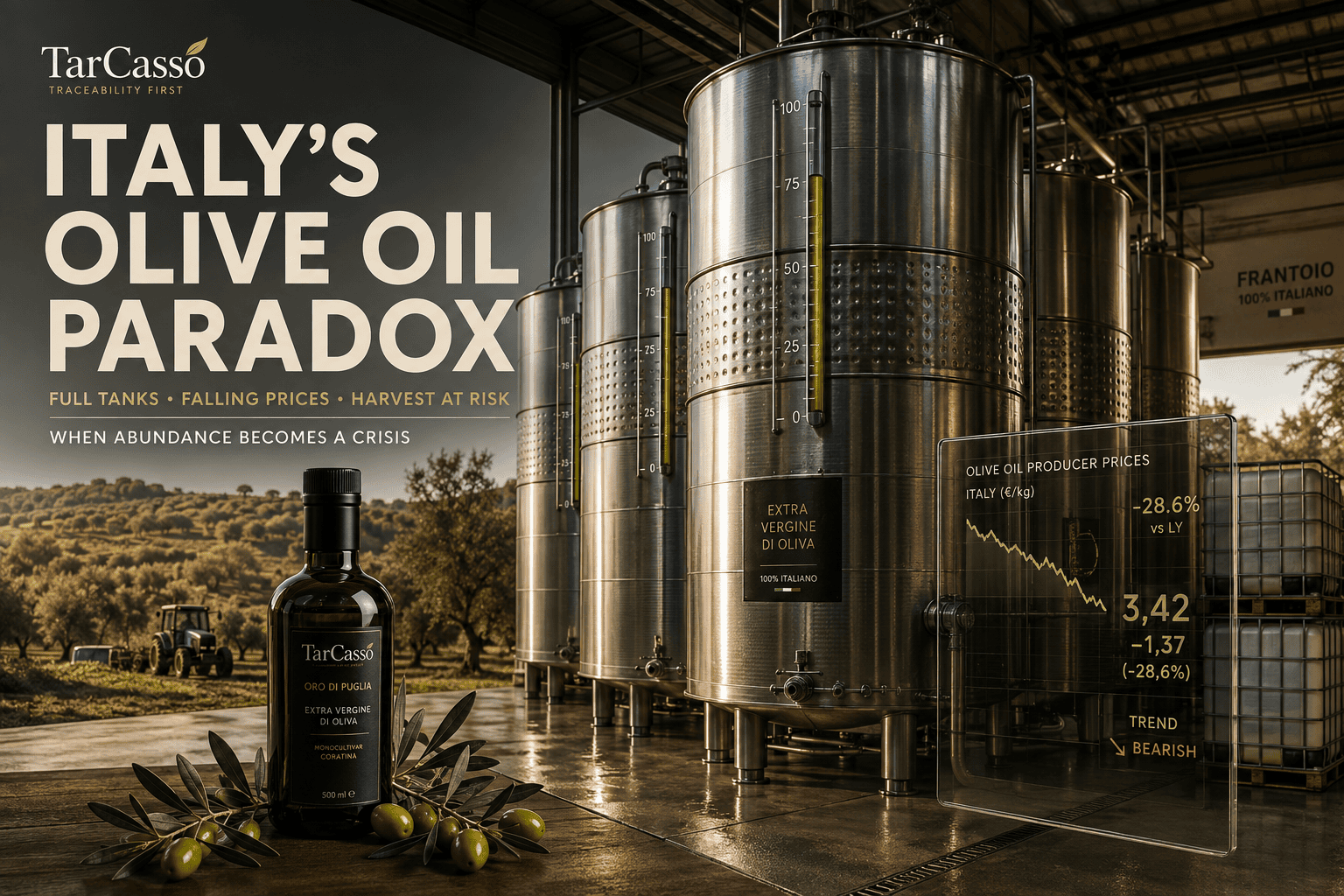
After years of shortages and record prices, Italy’s olive oil sector is suddenly facing the opposite problem: too much unsold oil, falling producer prices and mills running out of both storage space and liquidity.
Italy’s olive oil industry is entering an unusually difficult phase. In Puglia and Calabria, two of the country’s most important olive-growing regions, industry representatives and regional authorities are calling for the sector to be formally recognised as being in a state of crisis.
The problem is not simply that Italy is producing “too much” olive oil. It is a more complicated combination of high inventories, rapidly falling prices, expensive stock purchased during the previous season and restricted working capital
The numbers explain the pressure
According to the Italian Ministry of Agriculture’s official Frantoio Italia report, Italy held 258,480 tonnes of olive oil in storage at the end of June 2026 — 46.4% more than one year earlier. Extra virgin olive oil accounted for almost 207,000 tonnes, with EVOO inventories alone up 63% year-on-year. Stocks of Italian-origin EVOO had more than doubled.
The geographical concentration is striking. Puglia alone held around 85,600 tonnes, or 33.1% of all Italian stocks, while Calabria held another 31,700 tonnes. Together, the two regions accounted for more than 45% of the country’s stored olive oil.
Organic oil is also affected. Italy had more than 41,000 tonnes of organic virgin and extra virgin olive oil in storage, almost twice the level recorded a year earlier. Puglia and Calabria together accounted for more than half of that organic stock.
From scarcity to falling prices
Only a short time ago, olive oil was characterised by shortages and record prices. That environment encouraged mills and processors to buy olives and oil at high prices.
According to the Italian mill associations, wholesale oil was purchased during the previous campaign at an average of roughly €7–8 per kilogram, with peaks of €9–10. When market prices subsequently declined, many mills found themselves holding inventory worth considerably less than its acquisition cost.
International Olive Council data illustrate the reversal. Producer prices for EVOO in Bari stood at €5.65/kg in May 2026, 41.8% below the corresponding period a year earlier.
Part of the explanation lies outside Italy. Global olive oil production rebounded dramatically in 2024/25, increasing by an estimated 38% to 3.57 million tonnes after the previous years of scarcity. Spain, Türkiye and Tunisia recorded particularly strong recoveries, fundamentally changing the balance of the Mediterranean olive oil market.
Why full tanks are a serious problem
Unsold olive oil creates two problems simultaneously.
First, it occupies the tanks that mills will soon need for the 2026/27 harvest. Second, the money used to purchase last season’s olives remains tied up in that inventory.
This creates a potentially dangerous chain reaction: mills may lack both the physical capacity and the cash required to buy the next crop from farmers. Confagricoltura, Unapol and Assofrantoi warned in early August that some producers are already questioning whether harvesting will be economically viable if there is no reliable market for the resulting oil.
Puglia and Calabria have therefore asked the Italian government to recognise a formal state of crisis, while industry organisations are calling for measures to improve liquidity, ease access to credit and reduce the financial pressure created by existing inventories.
What does this mean for consumers?
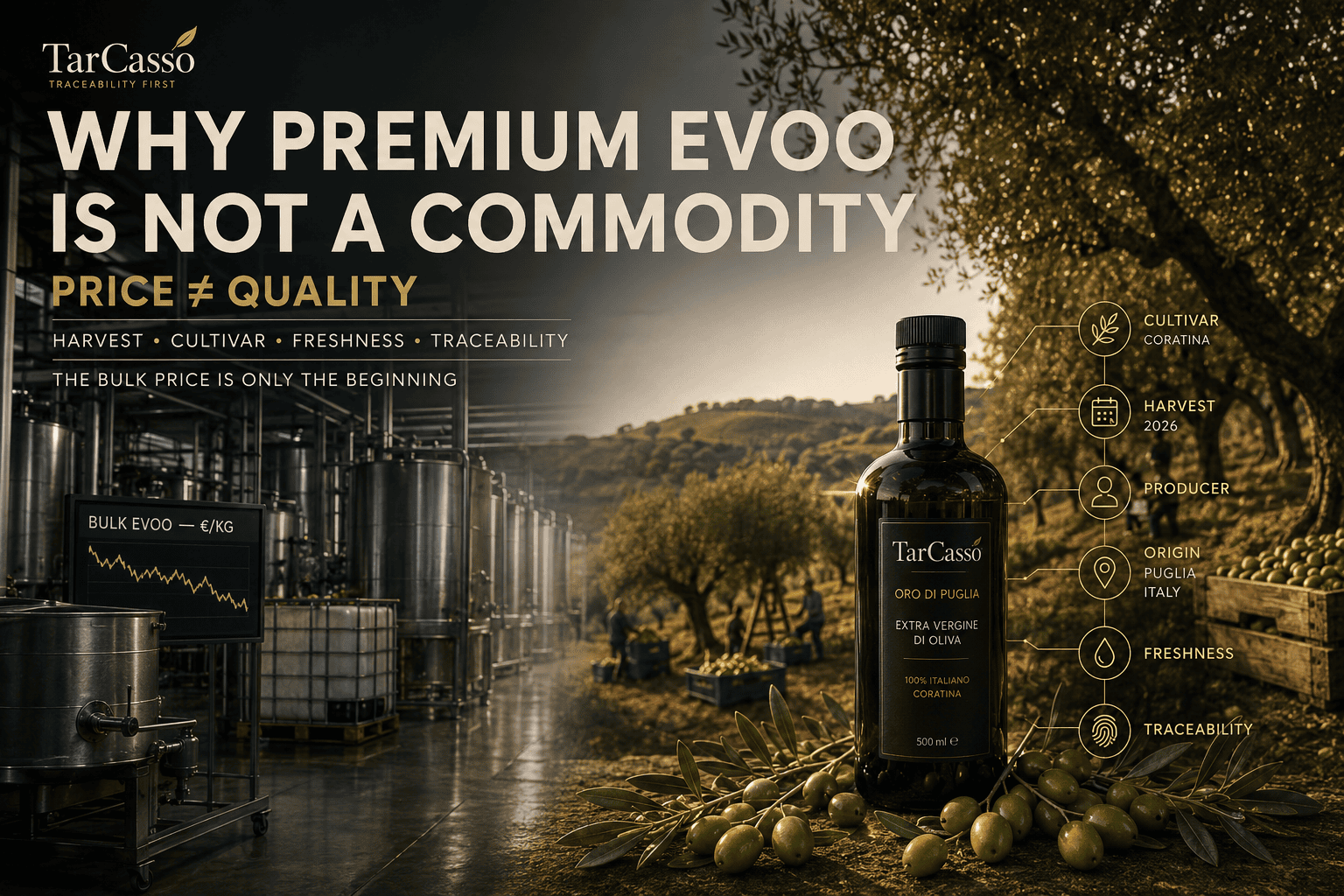
Falling bulk prices do not necessarily mean that every bottle of high-quality Italian EVOO should suddenly become cheap.
Commodity prices represent only one part of the final cost of a premium olive oil. Harvest timing, cultivar, yield, milling quality, storage under controlled conditions, laboratory testing, certification, packaging, logistics and distribution all remain significant.
More importantly, olive oil is not one homogeneous product. A large tank of anonymous bulk EVOO and a freshly harvested, traceable monovarietal oil from a specialised producer may technically belong to the same regulatory category, but they are very different products from a sensory, provenance and quality perspective.
The TarCasso perspective: quality needs differentiation
The current crisis exposes a structural weakness of the olive oil market: when olive oil is treated primarily as a commodity, price eventually dominates the conversation.
For premium EVOO, the more sustainable strategy is differentiation — by producer, cultivar, harvest, origin, freshness, chemical profile and traceability.
The paradox is therefore striking. Italy currently has too much olive oil in tanks, but not necessarily too much great olive oil in the hands of informed consumers.
The challenge for the industry is not simply to produce more or less. It is to create a clearer connection between quality, provenance and value.
That distinction may become increasingly important as Italy prepares for its next harvest.