Three cultivars. Three different oils. One new way of understanding extra virgin olive oil.
TarCasso started with a simple conviction: extra virgin olive oil can be much more than another premium food product on a digital shelf.
It sits at the intersection of Mediterranean culture, nutrition, agriculture, craftsmanship and increasingly sophisticated consumer expectations. Yet much of the olive oil market is still communicated through a surprisingly narrow vocabulary: premium, organic, cold extracted, high polyphenols, award-winning.
Those descriptions can be useful. But they rarely tell the whole story.
Who actually produced the oil? Which olive cultivar was used? When were the olives harvested? How quickly were they processed? What does the oil taste like? Which laboratory data exists? Which data belongs to the current harvest, and which relates to an older batch?
These are the questions behind TarCasso EVOO Intelligence.
It is our attempt to build a structured knowledge and evidence layer around the extra virgin olive oils we discover, taste, study and ultimately decide to present to the TarCasso community.
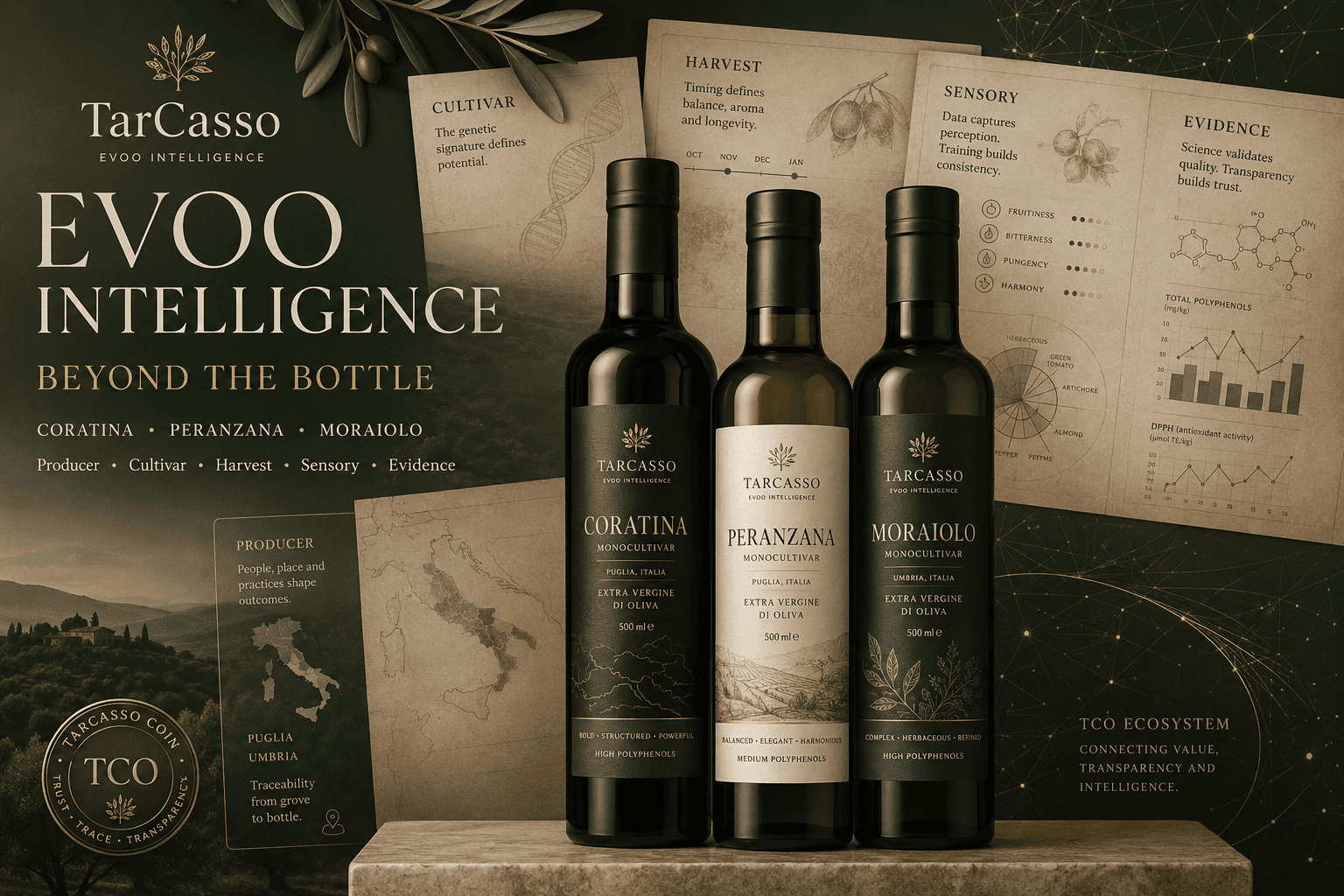
And our first practical case study begins with three very different monocultivar EVOOs from Italian producer Oilalà:
Organic Coratina. Peranzana. Moraiolo.
They are not three versions of the same product.
They are three reference points for understanding just how different EVOO can be.
From Selling Olive Oil to Understanding Olive Oil
TarCasso is building an ecosystem around evidence-backed Mediterranean longevity.
EVOO naturally plays a central role in that vision. It is one of the defining foods of Mediterranean dietary culture and an ideal bridge between agriculture, gastronomy, scientific research and everyday lifestyle.
But if TarCasso wants to build credibility in this field, simply sourcing premium bottles and placing them in a shop is not enough.
We need to understand what we sell.
And we need to make that understanding accessible.
This is why we created the EVOO Intelligence framework around six recurring questions:
Producer Intelligence
Who grows, mills and bottles the oil?
Cultivar Intelligence
Which olive variety — or varieties — define the oil?
Harvest Intelligence
When was the fruit harvested, and what do we know about the harvest campaign?
Production Intelligence
How quickly were the olives processed? How was the oil extracted, filtered, stored and bottled?
Sensory Intelligence
How does the oil express fruitiness, bitterness, pungency, aroma, balance and persistence?
Evidence & Traceability
Which laboratory reports, certifications, lot references and producer documents are available?
The objective is not to transform food into a spreadsheet.
It is to create context.
The First TarCasso Tasting Trio
Our initial Oilalà selection provides a useful way to demonstrate the concept because the three cultivars are deliberately different.
Organic Coratina — Power
Coratina is the most forceful reference point in our first tasting trio.
The Oilalà Organic Coratina is made from 100% Coratina olives and presents the characteristics that make this cultivar so useful for learning about structured EVOO: strong fruitiness, pronounced bitterness and an unmistakably peppery finish.
For someone used to mild supermarket olive oil, Coratina can initially be surprising.
That is precisely why we find it interesting.
Bitterness and pungency are not automatically flaws. In a characterful extra virgin olive oil they can form an important part of the sensory expression.
For TarCasso, Coratina therefore represents:
Power · Structure · Pungency
It is a strong reference point against which more delicate oils can be understood.
Peranzana — Balance
Peranzana moves the tasting experience in another direction.
Oilalà describes its monocultivar Peranzana as medium fruity, comparatively gentle and more approachable in its overall sensory profile.
This makes it particularly useful in a comparative tasting.
Quality in EVOO is not a competition to produce the strongest bitterness or the hottest finish.
Peranzana shows the opposite.
An olive oil can be distinctive through balance.
Its softer structure and more delicate aromatic character provide an instructive counterpoint to Coratina and make it particularly suitable for people beginning to explore monocultivar EVOO.
For TarCasso, Peranzana therefore represents:
Balance · Delicacy · Approachability
Moraiolo — Complexity
Moraiolo introduces a third reference point.
Its appeal lies in aromatic complexity and the interaction between fruitiness, herbaceous notes, bitterness and pungency.
The Oilalà profile includes references such as fresh grass, olive leaf, artichoke and green almond, combined with a structured but balanced finish.
Where Coratina demonstrates force and Peranzana demonstrates balance, Moraiolo helps us explore another dimension:
Complexity · Herbaceous Character · Depth
And together, the three oils become much more interesting than any of them would be in isolation.
They form a small learning system:
Coratina → Power
Peranzana → Balance
Moraiolo → Complexity
This is the idea behind the first TarCasso comparative EVOO journey.
There is no universal winner.
The objective is to understand the differences.
The TarCasso EVOO Intelligence Card
To make this approach repeatable, we are introducing a standardized TarCasso EVOO Intelligence Card.
Every selected oil can be assessed using the same basic structure:
Producer
Origin
Cultivar
Harvest
Production
Sensory profile
Certification
Laboratory information
Batch and traceability information
TarCasso View
Consistency matters because it allows different oils and different producers to be understood through the same lens.
But one element is deliberately missing:
an overall score.
We do not believe that a Coratina should receive 94 points while a Peranzana receives 89 simply because the former is more intense.
Nor do we believe that the oil with the highest published polyphenol number must automatically be the “best” oil.
Food is more complicated than that.
So is quality.
The Intelligence Card provides structure without pretending that complexity can be reduced to one universal number.
Evidence Before Marketing
Perhaps the most important element of EVOO Intelligence is what happens when the available information is incomplete or contradictory.
The easiest marketing approach would be to select the most impressive number available and put it in large letters on a product page.
TarCasso wants to do the opposite.
Our initial Oilalà research provides a good example.
A publicly available laboratory report for Organic Coratina dated December 2024 recorded total polyphenols of 854 mg/kg.
Oilalà’s current product information for the 2025/26 harvest, however, communicates a different figure of 371 mg/kg.
The same issue appears with Moraiolo.
A historical laboratory report recorded 779 mg/kg, while current producer information for the newer campaign communicates 389 mg/kg.
For Peranzana, an older lot-specific laboratory report for crop 2024/25 records 578 ± 162 mg/kg, but we do not yet have an equivalent laboratory report linked to the exact current TarCasso supply batch.
There is nothing inherently problematic about these differences.
Olive oil is an agricultural product.
Harvests change. Batches change. Analytical values change.
The important question is therefore not:
What is the highest number we can find?
The better question is:
Which number belongs to which oil, harvest, sample and batch?
That distinction is fundamental to the TarCasso Intelligence approach.
Historical laboratory evidence remains valuable.
But historical evidence should not automatically become a current-batch marketing claim.
Where current data has not yet been confirmed, our Intelligence Cards say so.
Current batch analysis: pending confirmation.
That may be less spectacular than placing the highest available polyphenol value on a banner.
We believe it is more credible.
Laboratory Data Is One Layer — Not the Whole Oil
Analytical information can tell us a great deal.
Free acidity, peroxide values, phenolic information and other parameters can contribute useful evidence about a specific olive oil sample.
But laboratory data cannot fully describe what happens when someone pours the oil into a tasting glass.
It cannot replace aroma.
It cannot replace bitterness.
It cannot replace pungency.
It cannot explain the producer’s philosophy, the cultivar identity or the cultural context of the place where the olives were grown.
This is why TarCasso treats laboratory evidence as one Intelligence Layer among several.
Our working principle is simple:
No single number defines a great EVOO.
Building Competence, Not Just Inventory
This is also why we are building individual EVOO Intelligence Dossiers on TarCasso.
The first dossiers cover:
Oilalà Organic Coratina
Oilalà Peranzana
Oilalà Moraiolo
Each dossier goes beyond the normal product description.
It explains why the oil was selected, what we know about its cultivar and production, how the sensory profile is described, what evidence is available and — equally important — what information still needs confirmation.
Over time, we intend to expand the Intelligence Library beyond these first three oils.
Different producers.
Different regions.
Different cultivars.
Different production philosophies.
That is important because EVOO Intelligence should never become an Oilalà catalogue.
Oilalà is simply the first practical demonstration of a producer-neutral TarCasso methodology.
Where TarCasso Coin Fits In
This also explains the role of TarCasso Coin — TCO.
TarCasso is neither trying to build an olive oil brand with a token attached to it nor a crypto project looking for a physical product narrative.
The sequence matters.
Real product first.
Knowledge and evidence around the product.
Digital utility on top.
TCO is designed as an optional utility layer within the TarCasso ecosystem.
It is not intended to represent ownership of olive oil.
It is not backed by a fixed quantity of EVOO.
It does not represent a claim on olives, harvests, plantations, producer revenues or TarCasso assets.
Its potential role is different.
TCO can help connect participation across the TarCasso ecosystem — commerce, access, community, curated experiences and future loyalty functionality.
In that sense, EVOO Intelligence and TCO serve very different purposes.
EVOO Intelligence builds product knowledge and trust.
TCO provides a digital utility layer around the ecosystem.
Keeping those functions separate is important.
The quality of a Coratina must come from the olives, the harvest, the producer, the sensory experience and the evidence.
Not from a token.
Physical Product, Digital Intelligence, Optional Utility
This increasingly describes the broader TarCasso model.
We start with real Mediterranean products and real places.
Around those products we build information.
Around the information we build community.
And digital infrastructure can then help connect those elements.
In simplified form:
EVOO
Physical product
↓
EVOO Intelligence
Producer · cultivar · harvest · sensory · evidence
↓
TarCasso Curation
Why we selected it
↓
TarCasso Commerce
Where the product can be discovered and purchased
↓
TCO Utility
Optional digital access and participation layer
This order is intentional.
Technology should support the real-world experience rather than replace it.
Why We Are Doing This
TarCasso is still early in its EVOO journey.
We do not claim to know everything about olive oil.
That would contradict the entire concept.
Our objective is to build competence openly and systematically.
We want to ask better questions.
We want to work with producers who are willing to provide better answers.
We want to learn how cultivars differ.
We want to compare harvests.
We want to understand laboratory reports rather than simply quote them.
We want to taste the oils ourselves.
And as our own TarCasso batches arrive, we want to connect producer information increasingly closely with the actual bottles being offered through our ecosystem.
The Intelligence Library will therefore evolve.
Information will be updated.
New harvests will replace old ones.
Additional evidence will become available.
TarCasso sensory assessments will complement producer descriptions.
And new EVOOs will be added.
That is not a weakness of the system.
It is the system.
From Three Oils to a Knowledge Platform
Organic Coratina, Peranzana and Moraiolo are only the beginning.
But together they already demonstrate the central idea behind TarCasso EVOO Intelligence:
An olive oil becomes more interesting when we understand what is behind the bottle.
Not just the brand.
Not just the price.
Not just the polyphenol number.
The producer.
The cultivar.
The harvest.
The process.
The sensory character.
The evidence.
And eventually the relationship between all of them.
TarCasso wants to participate in the Mediterranean longevity economy not simply as another seller of olive oil and not simply as another issuer of a digital token.
We want to build an ecosystem in which real products, evidence, education, commerce and digital utility reinforce each other.
The first three EVOO Intelligence Dossiers are a small but tangible step in that direction.
Three cultivars. Three reference points. One growing body of knowledge.
Welcome to TarCasso EVOO Intelligence.