Falling olive oil prices may be good news for consumers. But the price of bulk olive oil tells surprisingly little about the value of a truly great extra virgin olive oil.
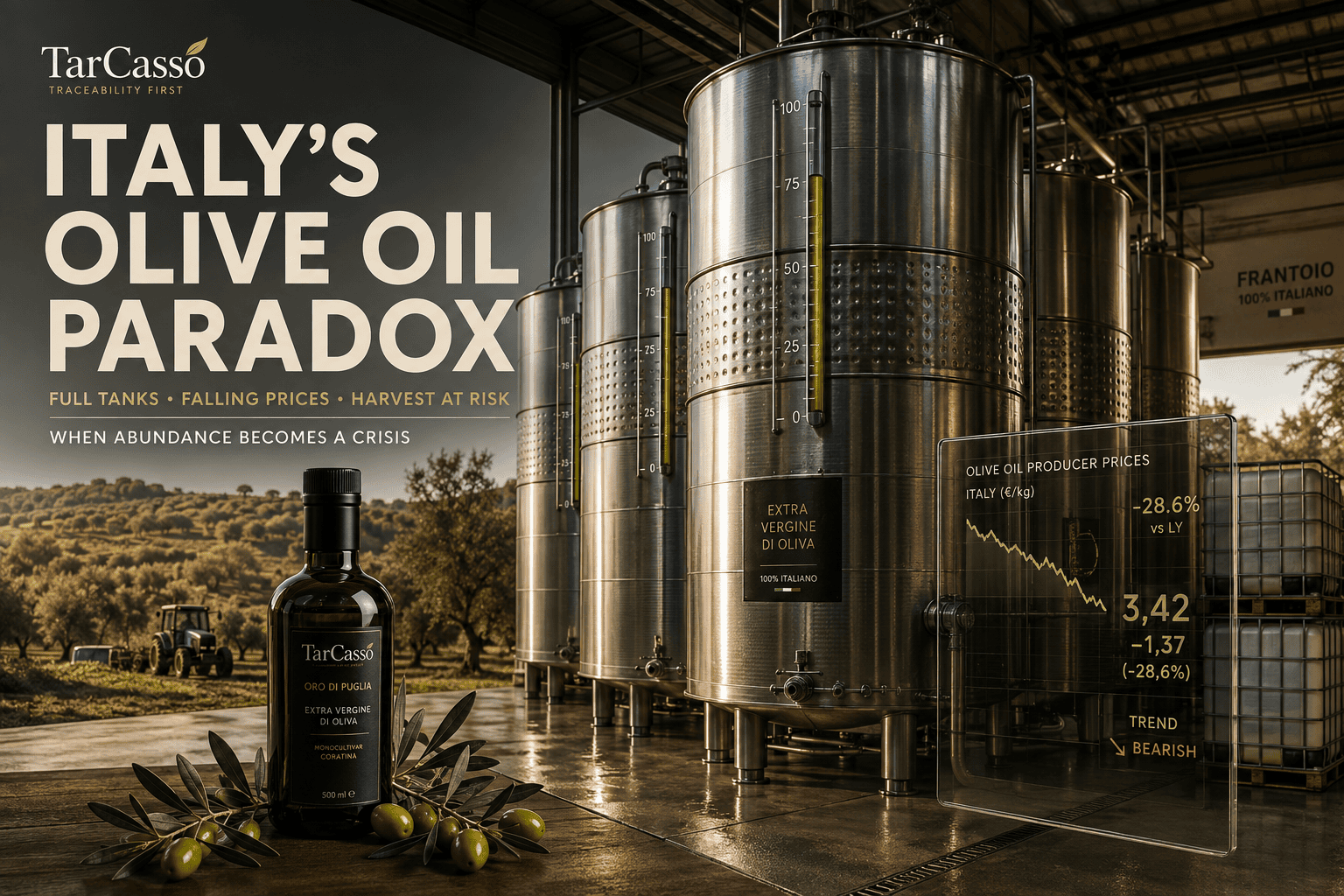
Italy’s olive oil market is experiencing a remarkable reversal. After years of scarcity and record prices, inventories are high and producer prices have fallen sharply. In Bari, one of Europe’s key olive oil markets, extra virgin olive oil was quoted at €5.65 per kilogram in May 2026 — 41.8% below the corresponding period a year earlier.
That raises an obvious question:
If olive oil prices are falling, shouldn’t premium EVOO become much cheaper too?
Not necessarily.
The reason is simple: olive oil can be traded as a commodity. Great extra virgin olive oil should not be understood as one.
“Extra Virgin” Is the Starting Point
Extra virgin olive oil is a legally defined category. Under EU rules, EVOO must meet a series of chemical and sensory requirements. Among them, free acidity may not exceed 0.8%, and the oil must have no median sensory defect while showing detectable fruitiness.
These standards are important. But they represent a minimum classification threshold, not a ranking system for excellence.
Two oils can therefore both legally qualify as extra virgin while being dramatically different in origin, freshness, cultivar, aroma, phenolic composition, harvesting strategy and production cost.
There is also no separate EU legal category called “premium extra virgin olive oil.”
Premium is created above the regulatory threshold.
The Yield Paradox
One of the most important differences begins before the olives even reach the mill.
Producers seeking maximum volume generally have an economic incentive to allow olives to accumulate more oil as they mature.
Premium producers may make a different decision.
They can harvest earlier, when the olives are greener. Scientific research shows that early-harvest oils frequently contain higher concentrations of phenolic compounds and display stronger bitterness and pungency. At the same time, less mature fruit can produce a lower oil yield.
This creates what we might call the EVOO yield paradox:
Producing less oil from the same quantity of olives can sometimes be the deliberate price of producing a more distinctive oil.
In a commodity model, yield is king.
In a quality model, the objective is different.
Cultivar Matters
Olive oil is sometimes presented to consumers as though it were one homogeneous product.
It is not.
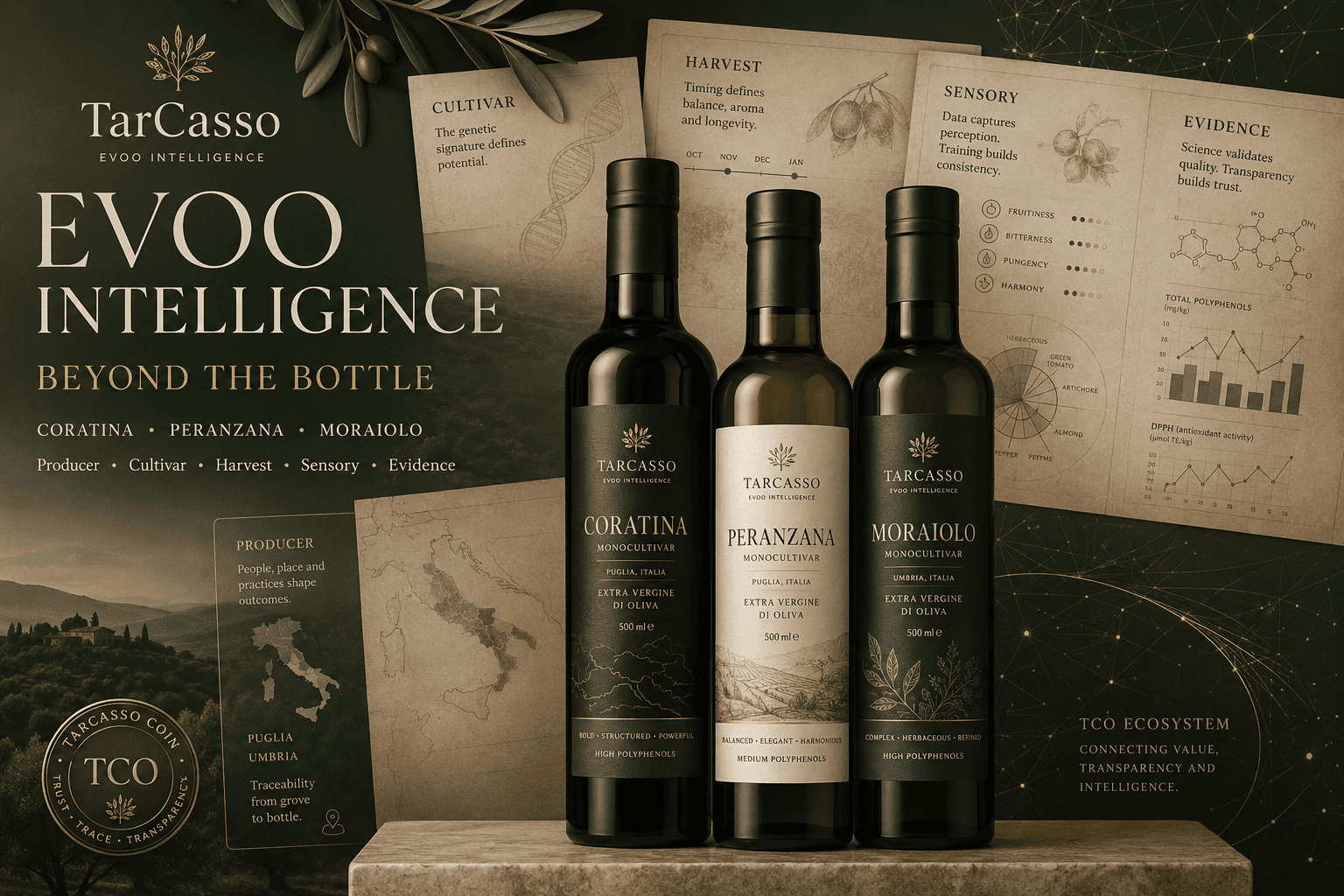
Just as grape varieties help define wine, olive cultivars influence the character of an EVOO. Research confirms significant differences in fatty-acid profiles, phenolic composition and sensory characteristics between cultivars.
A Coratina, for example, is not simply interchangeable with every other Italian olive oil.
Cultivar, terroir, maturity and processing interact to produce different sensory and chemical profiles.
For consumers interested in quality, knowing which olive produced the oil therefore matters.
Freshness Matters Too
Unlike wine, olive oil generally does not improve through ageing.
Oxygen, light and time gradually degrade it. The International Olive Council specifically identifies light and exposure to oxygen as important threats to olive oil quality and recommends protecting oils from both.
That makes another distinction important:
Inventory is not the same thing as freshness.
Italy may currently have large volumes of olive oil sitting in storage tanks. That does not mean those stocks are equivalent to carefully produced oil from the forthcoming harvest.
EU rules even allow the harvest year to be stated for virgin and extra virgin olive oils under specified conditions, reflecting the relevance of harvest identity to these products.
For consumers looking for premium EVOO, questions such as When was it harvested? How was it stored? Where was it produced? can be more informative than simply asking whether the bottle says “extra virgin.”
What Are You Actually Paying For?
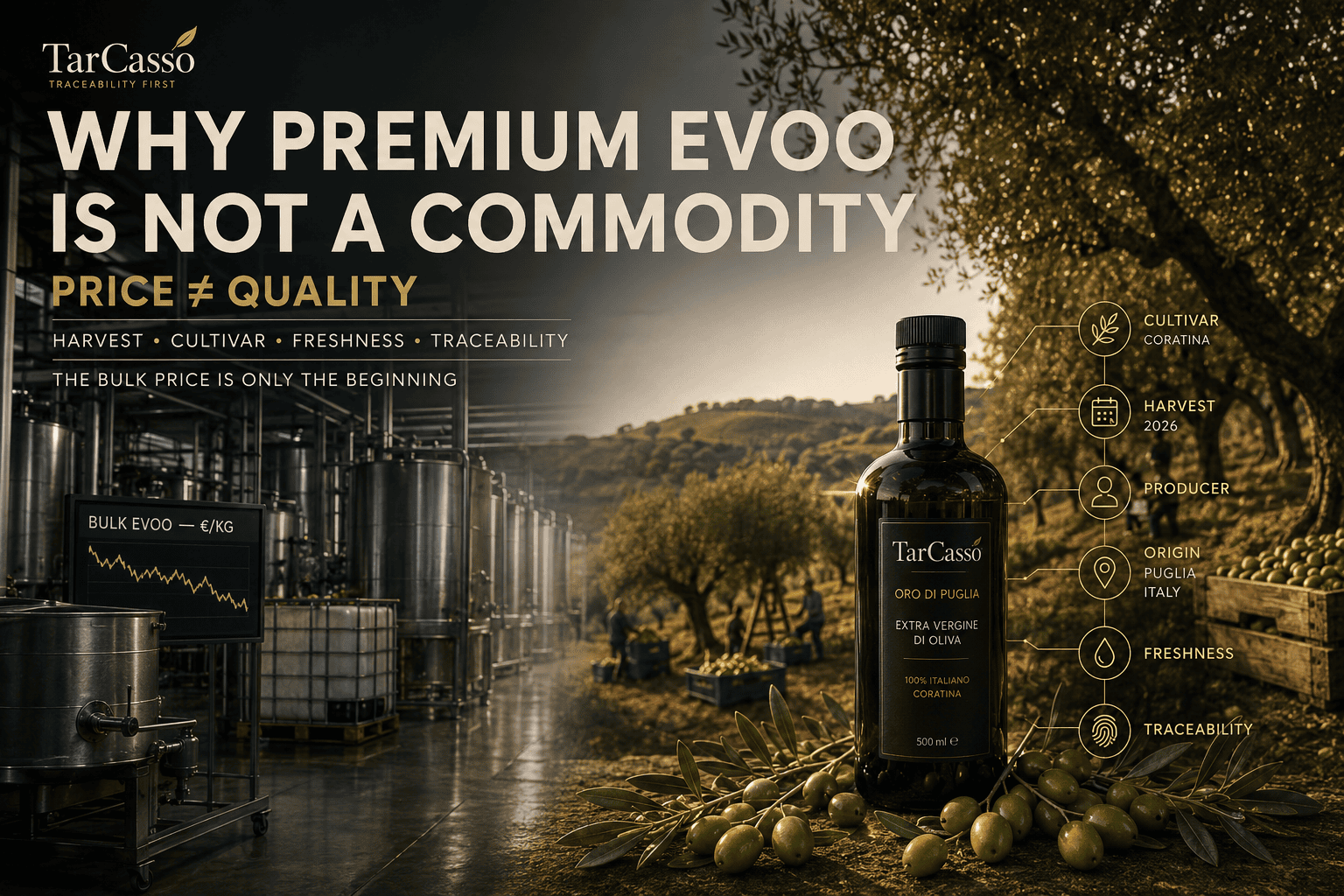
The price of premium EVOO is therefore not simply the wholesale price of olive oil multiplied by the volume inside the bottle.
It may reflect decisions made throughout the entire production chain:
| Commodity Logic | Premium EVOO Logic |
|---|---|
| Maximise volume | Optimise quality |
| Oil as interchangeable product | Cultivar and origin matter |
| Bulk market price | Producer-specific value |
| Maximum extraction yield | Earlier or selective harvest possible |
| Minimum legal classification | Quality above the legal minimum |
| Anonymous inventory | Traceable harvest and producer |
| Price-led purchasing | Sensory quality, freshness and provenance |
None of these characteristics automatically guarantees that an expensive bottle is a great olive oil.
But they explain why great olive oil cannot be valued solely by reference to a bulk-market quotation.
Traceability Changes the Question
- A commodity market asks: How much does olive oil cost per kilogram?
- A premium market should ask: Which olives? From where? Harvested when? Produced by whom? Processed how? Stored under what conditions?
That shift in questions is fundamental.
Traceability transforms EVOO from an anonymous agricultural product into something consumers can evaluate.
It creates a connection between the bottle and the orchard, cultivar, harvest and producer behind it.
The TarCasso Perspective
The current Italian olive oil crisis makes this distinction especially important.
Falling bulk prices may help rebalance the market after several extraordinary years. But they should not persuade consumers that all EVOO has suddenly become the same product.
Quite the opposite.
When warehouses are full and price competition intensifies, provenance, freshness and measurable quality become even more important ways to distinguish one oil from another.
For TarCasso, this leads to a simple principle:
We do not want consumers to buy olive oil merely because it is expensive. We want them to understand why a particular olive oil has value.
That means looking beyond the words extra virgin.
Look for the cultivar.
Look for the producer.
Look for the harvest.
Look for the origin.
Look for evidence of quality.
And above all, look for traceability.
Because olive oil may be traded as a commodity.
Great extra virgin olive oil should not be understood as one.